
News
Justine, Russell Sage College ’81, and Jim Mullen ’80 Fund RPI Projects in Computational Biology
Projects include AI and quantum computing
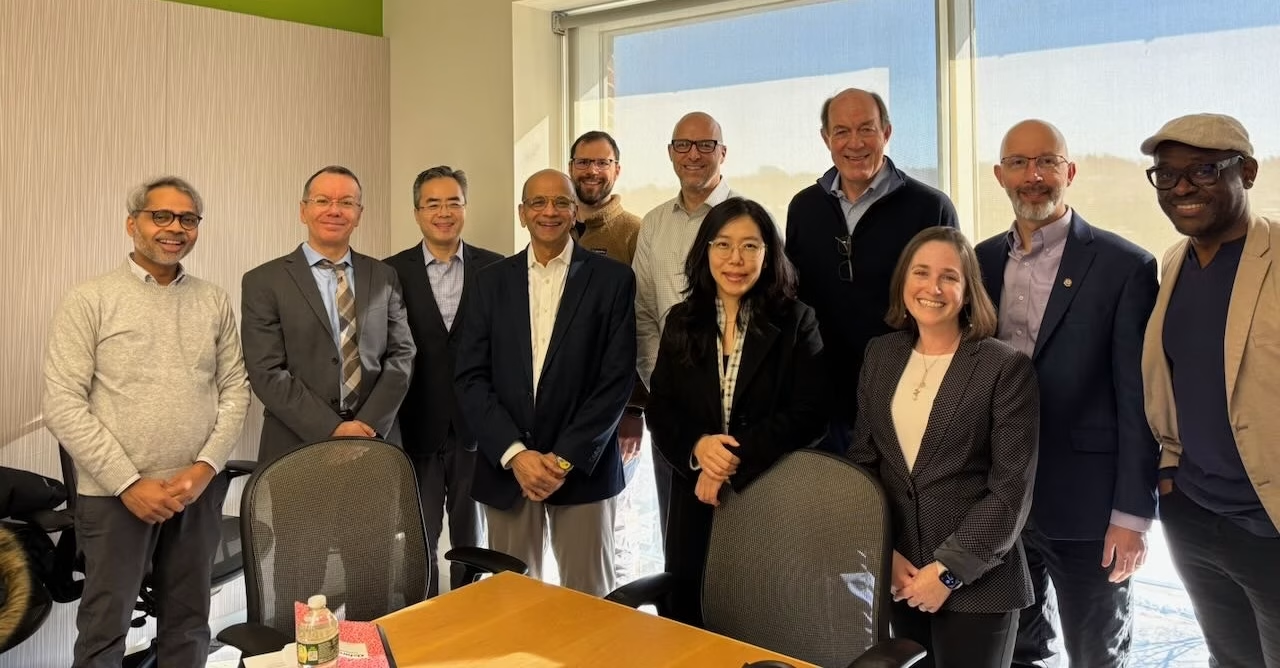
Justine, Russell Sage College ’81, and Jim Mullen ’80 have generously donated to RPI in support of several research projects and a workshop in computational biology, with emphases in artificial intelligence, and quantum computing—all priorities outlined in the RPI Forward strategic plan.
“Funding computational biology research at the place where I began my education, and ultimately my life sciences career, seemed like a full circle moment — giving to an area and place where it all started for me,” said Jim Mullen ’80. “Justine and I are thrilled to support research in an industry I built my career on. We hope this gift, which supports a key priority at RPI, will fuel the future of the biopharma industry and serve as a catalyst for faculty and student research.”
Breakthroughs in fundamental science often occur at the interface of broadly different research areas. Enabling life sciences with high performance and quantum computing, artificial intelligence, and machine learning will lead to the next generation of research and training in computational biology. While RPI remains at the forefront of these significantly advancing technologies, this commitment will continue to accelerate RPI’s important work in these areas.
“We are so grateful for the support from Jim and Justine, which will allow our faculty and students to remain at the forefront of rapidly growing fields in computational biology,” said Robert Hull, Ph.D., vice president for research at RPI. “In addition to applying computational methods to biological research, these projects focus on global issues that affect humanity.”
This contribution supports seven research projects and one workshop, led by eight faculty members working with six graduate students and one post-doctoral researcher. The Mullens’ investment further supports the Institute’s priorities in both scaling research excellence by empowering graduate student research, and in strengthening and extending education.
“This gift from Jim and Justine Mullen touches so many priorities at RPI — computation, life sciences, and biotechnology, while supporting faculty and graduate student research,” said Martin A. Schmidt ’81, president of RPI. “And with alumni engagement as a priority in our strategic plan, RPI Forward, I am especially grateful to the Mullens for their continued support and generosity, and for giving back and staying connected to RPI in a way that is meaningful to them.”
Following a request for proposals to RPI faculty and students, a faculty panel narrowed the research project list down to the following:
- “Deep Learning Framework for Dose-Constrained Cryo-XRF in Cellular and Vesicle Imaging” – Dr. Edwin Fohtung, associate professor in materials science and engineering, and graduate student, Jackson Anderson.
- “The Geometry of Thought: How Physical Network Morphology Shapes Neural Dynamics” – Dr. Xiangyi Meng, assistant professor in physics, applied physics, and astronomy, along with a post-doc researcher.
- “AI-enabled Causal Functional Connectivity from Neural Dynamics” – Rahul Rahul ’11 Ph.D., assistant professor in biomedical engineering, and graduate student, Joydip Paul.
- “Unveiling the Chirality Code of Cancer: Chirality-Resolved Oncogenic Mutations” – Dr. Ji Young Kim, assistant professor in chemical and biological engineering, along with a graduate student.
- “AI-Assisted Biophysical Modeling for Tailored Muscle Regeneration” – Dr. David Corr P’25, professor in biomedical engineering and director of CeMSIM, Dr. Douglas Swank, professor in biology, and Stefan Radev, assistant professor in cognitive science, along with graduate student, Brenda Gomez-avila.
- “Predictive Redesign of Difficult-to-Characterize Enzymes Using Machine Learning” – Dr. Mattheos Koffas, professor in chemical and biological engineering; Dr. Mohammed Zaki P’26, professor in computer science, and graduate student, Hana Zeghal
- “Learning the language of time: Developing a Biological Large Language Model (Bio-LLM) to predict the downstream cellular output of the circadian clock” – Dr. Pingkun Yan, PK Lashmet chair professor and department head of biomedical engineering, Dr. Jen Hurley, professor and department head of biological sciences, and graduate student, Ethan Rapa.
- “Quantum Computing in Medicine and Life Sciences” Workshop – Dr. Deepak Vashishth, Yamada Corp. chaired professor in biomedical engineering and co-director of CEPM, Dr. Christopher Carothers, professor in computer science and chief scientific officer of FOCI.